The thunderbird’s name is said to originate from the belief that the beating of its enormous wings causes thunder and stirs the wind. The Lakota name for the thunderbird is Wakį́nyąn, from wakhąn, meaning “sacred”, and kįyą, meaning “winged”. The Kwakwaka’wakw have many names for the thunderbird, and the Nuu-chah-nulth (Nootka) called it Kw-Uhnx-Wa. The Ojibwa word for a thunderbird that is closely associated with thunder is animikii, while large thunderous birds are known as binesi.
The thunderbirds or Rocs, as they are sometimes referred to, are legendary creatures in certain North American native peoples history and culture. They are frequently depicted in their oral histories and songs and are considered a supernatural bird of power and strength. The Thunderbird symbol is one of the most dominant icons in indigenous American Indian culture.
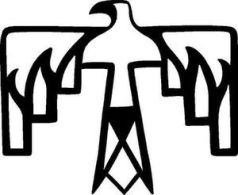
Though the thunderbird’s origins are largely unknown, reports of these elusive creatures go back centuries, and some researchers believe that they may be descendants of the extinct Pterosaurs which first appeared in the late Triassic period some 228 to 66 million years ago until the end of the Cretaceous period.

PteranodonThunderbird Sightings.
19th Century
-
In April 1890, two cowboys in Arizona allegedly shot and killed a giant bird-like creature with an enormous wingspan. It was described as having smooth skin, featherless wings similar to a bat and an alligator-like face. The description bore similarities to that of a prehistoric pterodactyl—an animal whose existence was known at the time. On dragging the creature back to town, they nailed the carcass across the entire length of a barn, where it was photographed with wings outstretched.
According to crypto zoologist Mark Hall, the Tombstone Epitaph printed a story about the capture of a large, unusual winged creature on April 26, 1890. Beyond this solitary story, however, no one has discovered any historic corroboration that this event ever occurred; it is usually considered an urban legend. Utterly fictional tall tales were not an uncommon feature in newspapers during this era. To date, no one has ever produced a copy of the alleged photograph.
Early 20th Century
-
On April 10, 1948, three individuals in Overland, Illinois spotted what they at first thought was a passing plane. However, when it began flapping its wings they realised that the ‘plane’ was nothing of the sort. Shortly after this encounter, a man and his son saw what they described as being an enormous bird creature over Alton, Illinois. They estimated the creature to be at an altitude of at least 500 ft. They described the shadow it cast on the ground as being the same size of a small passenger plane.
Late 20th Century
-
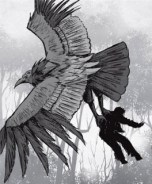 In the late twentieth century there was a spike in Thunderbird sightings. Among the most controversial of them was the Lawndale, July 25, 1977 encounter. It took place around 9 pm. As three boys were playing in a residential back yard, they were approached by two large birds who began chasing them. Two of the boys managed to evade them but the third, ten-year-old Marlon Lowe, was captured by one of them when it clamped its talons onto his shoulders and lifted him two feet into the air. The terrified youngster fought against his winged assailant, which finally released him.
 -
In 2002, an Alaskan pilot flying from the village of Manakotak to the village of Togiak, with several passengers aboard, reported an encounter with a large, raptor-like bird with a wingspan almost equal to his airplane. In an article published in the Anchorage Daily News the pilot was quoted as saying that the bird looked like something out of Jurassic Park. The article further stated that other people who lived in the region had also witnessed a similar creature on several occasions around the same time.
The above pilot’s description of the ‘bird’ is notable in that he likens it to ‘something out of Jurassic Park’, suggesting the creature was not feathered. This would appear to rule out the possibility of it being a Condor, Eagle, or any other known large raptor bird. The Condor is the common name for two species of New World vultures, each in a monotypic genus. They are the largest flying land birds in the Western Hemisphere.
The Andean condor (Vulture gryphus) which inhabits the Andean mountains.

The California condor (Gypnogyps californianus) currently restricted to the western coastal mountains of the United States and Mexico and the northern desert mountains of Arizona.
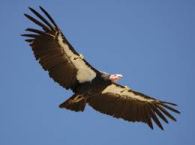
Could there be large, surviving, species of avians – throwbacks to earlier epochs – who have the capabilities to carry off animals and children? Certainly, such a creature would have a wingspan way in excess of the largest birds know today in order to do so. Herein lies a paradox. If such a species does exist how have they managed, thus far, to avoid detection for so long?
What little photographic evidence there is of these Thunderbirds is dubious, as are videos purporting to show them in flight. The problem with many images is the lack of perspective. The size of the bird is impossible to calculate when seen against a featureless aerial background, as the above image demonstrates. To calculate it’s true size would require an image showing known objects within the same field of view as the bird, such as buildings or other objects with measurable dimensions (see image below).
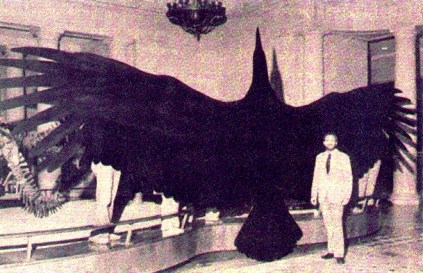
For the sake of argument, let’s assume we know the man in the forefront of this image to be 6 ft tall, then this would make this bird’s wingspan to be approximately 25 ft. and it’s length from beak to tail approximately 10ft.
Many civilisations use culturally relevant stories to instil in their people the notion and importance of fellowship and respect for the power of nature. Moreover, the native American Thunderbird serves as an allegorical figure, illustrating deeper truths concerning the struggles of life and the changes within it. It reminds its people that change is inevitable. It is seen as an agent of change that helps determine behaviour within the dynamics of both family and community.
As stated earlier in this article, the origins of the Thunderbird are largely a mystery. Some researchers are of the opinion that the legend is based on the sightings of real birds, some even positing the argument that early sightings could have been of descendants of the pterodactyl dinosaur species. In so doing, the thunderbird has been transformed from being a mythical spiritual creature into a potential cryptid. Our Westernised ethnocentric biases have reduced it to little more than a zoological curiosity.
© David Calvert 2016
Please note that at the bottom of each blog page there is a “Comments” box and a “Like” button, should you feel inclined to use them. Thank you.
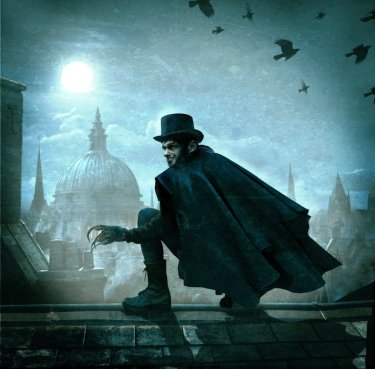
 Some months after the first sightings in 1838 Sir John Cowan
 muddled summary of the legend which lacked a single primary reference to his source material. The various assaults that occurred during 1837-38 suggested that Jack was trying desperately to locate somewhere safe to hide, or was perhaps looking for a friendly ‘agent’ who could assist him in locating his misplaced flying saucer.
 According to media reports at the time, the creature was first sighted by three females ranging from 14 to 21 years old: sisters Liliane and Valquíria Fátima Silva, and their friend Kátia Andrade Xavier. They alleged to have seen the creature on the afternoon of January 20, 1996. Their description of the creature was that of
  will have noted that the depiction bears no resemblance whatsoever to a canid. The family Canidae is divided into two tribes: the Canini (dogs, wolves, jackals, and some South American “foxes”) and the Vulpini (true foxes). Given that all ‘Chupacabra’ are described as being canid- like begs the question as to how it was given the same designation.
 shaped UFO over the


 commonly used by the people indigenous to the region, and are part of their history and mythology. Stories of the Yeti first emerged as a facet of Western popular culture in the 19th century. However, it is believed that the search to find the Yeti can be traced back to the time of Alexander the Great, who in 326 BC set out to conquer the Indus Valley. Having heard stories of the creature he demanded to see one for himself, but local people told him they were unable to present one because the creatures could not survive at that low an altitude.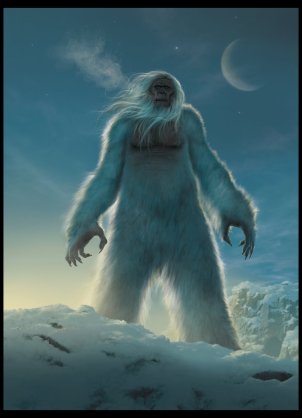



 An Analysis by Jan Harold Brunvand, an American







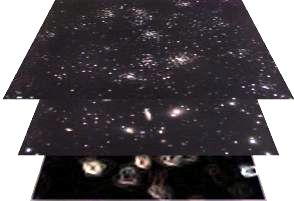 2-brane. Resulting from M-theory equations, they are membrane-like structures consisting of from 1-11 dimensions. The idea is that these branes exists in an 11-dimensional space, and that they contain universes. According to this model our universe is a 3-brane. This 11-dimensional space is called the “bulk” in Brane cosmology.
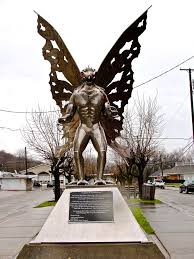
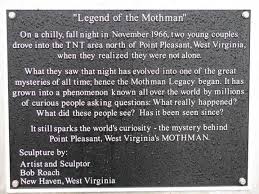
 In the aftermath of the Mothman sightings case in Point Pleasant, West Virginia, (a case of high strangeness in itself), John Keel, the author of ‘The Mothman Prophecies,’ met and interviewed a man named Woodrow Derenberger who related the following story to him.
  theory
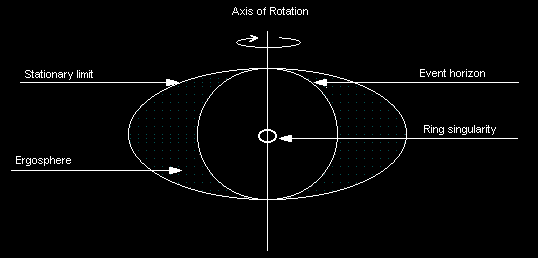
 electrical field is created which would rip the fabric of spacetime, thus creating a wormhole that would link the two chambers. Since time runs slow for a moving object – according to Einstein’s special theory of relativity – one of the chambers is then sent out on an incredibly fast journey and returned. At either end of the wormhole time would pass at different rates. Anyone falling into one end of the hole would instantaneously be hurled into a past or future time when they emerged from the other end.
 paradoxes that could ensue because of it. One such incongruity is the “Grandfather Paradox”. If a person travels back in time and kills his grandfather how then could he have been born in order to make the journey into the past? Sceptics see this an assault on common sense, so they argue that there must be a natural law that prevents it. This is the selfsame argument that was aimed at space flight and journeying to the Moon, to name but a few other so-called impossibilities. To discover what might exist in nature to prevent such apparent inconsistencies we need to delve into the world of quantum physics, and the “multiverse” theory.
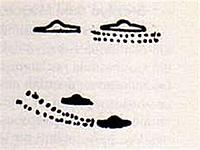 comes from Niaux, in the French Pyrenees. It shows two domed UFOs side by side, one of which is apparently giving off a trail of sparks, as is reported in many contemporary sightings. It is estimated that this drawing is around 14,000 years old .This is not an isolated example. There are literally hundreds of images like these throughout the world from disparate cultures, so we cannot simply dismiss them out of hand. Have ancient artists depicted what may be some of the earliest temporal sojourns of the same time travellers we see today in our skies?
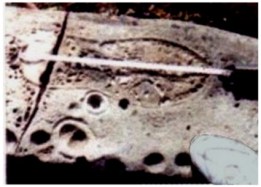 China, in 1997. It is believed to have been laid down some 200 million years ago. It is clearly the impression of a shoe with a leather sole. By any normal definition this is utterly impossible as, according to anthropological studies, it has been determined that the most modern humans came onto the scene around 200, 000 years ago. Nor is this the only footprint to have been discovered that predates humanity by millions of years. Some prints, particularly the barefooted variety, are that of modern humans (see link):
 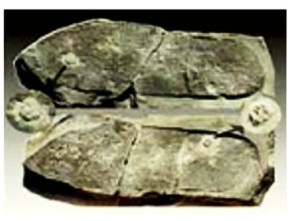 discovered within a block of Utah shale. Beneath the shoe cast a squashed trilobite, a small prehistoric marine arthropod, was discovered. It had apparently been crushed by the individual who had walked over it. Trilobites became extinct long before the emergence of even the most primitive ancestors of mankind walked the Earth.
 This iconic figure with its bulbous head and spindly body, is what ufologists term as a “Grey alien”, which they believe comes from the
 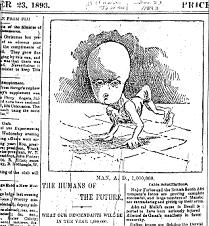 we do. They even appear to act and think as we do. For some ufologists and scientists this flies in the face of reason. A truly alien species, they believe, would be nothing like us anatomically, or culturally, because their evolutionary paths would be entirely different to that of our own. If we apply the time travel hypothesis, however, these apparent inconsistencies suddenly make some kind of sense.
 occultusregnum